Travel advisor Daniel Coffin thought he was heading to Quebec City to celebrate his 50th birthday at a bucket-list concert — what he found instead was Europe hiding inside Canada, one carved ice glass at a time.
At a Glance
Quebec City's Valcartier Vacation Village ice hotel is a sprawling resort complex with 20–30 themed rooms, ice sculptures, and drinks served in carved-ice glasses, plus waterslides and indoor water parks. The old city itself resembles Paris, offering European architecture and culture without transatlantic travel, best experienced by staying downtown and engaging with locals.
Picture this: a glass carved from a solid block of ice, filled with Canadian maple liquor, handed to you inside a hotel built entirely from snow. Outside, the Quebec winter is unrelenting. Inside, coloured lights pulse through walls of sculpted ice, and the air carries that particular stillness that only frozen things can hold. For Daniel Coffin, a travel advisor based in Canada, this was the moment a birthday getaway became something far more significant. "It was really tasty, really cool experience," he recalls, and while the words are simple, the weight behind them is not. It was the kind of moment that resets a person's expectations of what travel can offer — and resets an advisor's ability to speak to clients with genuine authority.
A Milestone Birthday with a Metal Soundtrack
Coffin arrived in Quebec City in March 2026 with a clear mission: celebrate his 50th birthday by seeing one of his favourite metal bands perform at the Videotron Centre, the storied arena where the Quebec Nordiques once played. Anthrax opened the show. He had listened to both bands since he was a teenager, and there was something deeply satisfying about marking half a century of life with music that had soundtracked so much of it. He made the trip with his partner Brenda, just the two of them, a focused and personal getaway. What neither of them anticipated was how thoroughly Quebec City would steal the show from the concert itself.
It started the morning after the performance, down near the St. Lawrence River by the historic Hotel Frontenac. A tobogganing hill had been set up along the waterfront, and Coffin and Brenda found themselves taking run after run, first solo, then together. At the bottom of the hill, vendors were doing something that stopped them both in their tracks. Coffin describes it with the kind of precision that only comes from paying close attention: "They pour maple syrup into the snow, hard pack snow, and then we will put a stick around it and roll — it becomes a lollipop." Cold, sweet, unmistakably Canadian. It was a small thing, but it was the first sign that Quebec City was going to keep surprising them.
The Ice Hotel That Turned Out to Be an Entire World
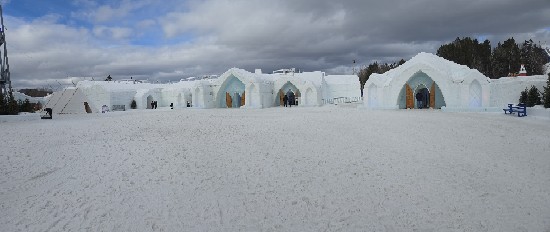
The following day brought the trip's undisputed centrepiece: a visit to the Valcartier Vacation Village and its famous ice hotel. Coffin admits they arrived expecting to see a novelty — an impressive structure, a few themed rooms, and then back to the city. What they encountered was something far more expansive. The hotel itself contained somewhere between 20 and 30 rooms, each designed around a different concept, with distinct lighting schemes and layouts ranging from intimate couples' retreats to large family suites with three beds. Ice sculptures filled the lobbies. The bar served drinks poured into glasses formed from carved blocks of ice. A restaurant offered meals at tables made of solid ice. There was even a slide, and Coffin is entirely unapologetic about the fact that a 50-year-old man made full use of it.
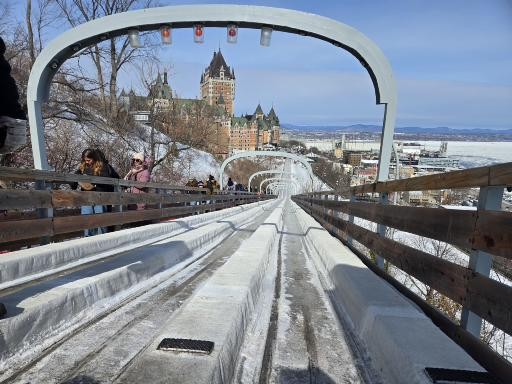
But Valcartier turned out to be far more than the ice hotel. Outside, there were waterslides, toboggan runs, and ice skating rinks. Inside the broader resort complex, an indoor water park meant that families could swap snowsuits for swimsuits without ever leaving the property. "We thought it was just the ice hotel and that's all there was to see," Coffin says. "But as soon as we entered, we found it was a whole vacation village." The scale of the place, and the ingenuity of offering summer and winter activities side by side in the heart of a Quebec winter, was the kind of detail no brochure had prepared him for. It is also exactly the kind of detail a well-travelled advisor can now pass on to clients with complete confidence.
Europe Without the Transatlantic Flight
Beyond Valcartier, Quebec City itself delivered a surprise of a different order. Coffin and Brenda had visited France and several other European countries before this trip, which made what happened next all the more striking. Walking through the old city, taking in the architecture, the language, the rhythm of daily life along cobblestoned streets, something clicked. "Even within our own country, it felt like we were in another continent altogether," Coffin reflects. The comparison to Paris was not casual or touristic — it was the considered observation of someone who has actually stood in both places. For Canadian travellers who dream of Europe but face barriers of cost, time, or accessibility, this is a genuinely useful insight, and one that only a first-hand visit could have unlocked.

The cultural immersion deepened during a bus tour of Quebec City and its surrounding areas. Their driver, a local who had grown up in the region, guided them through his personal history as much as the city's official one, pointing out the house where he was born and the school he attended. He had made maple syrup in his own backyard and brought some along to share with the group. For Coffin, moments like these are what separate a trip from an education. "We felt we learned more just by talking to the people and hearing their stories," he says. The food, the language, the architecture, the maple syrup at every turn — Quebec City, experienced this way, is not a destination so much as a full cultural immersion.
What a Concert Crowd Taught Him About a City
One of Coffin's sharpest observations came not from the ice hotel or the old city streets, but from inside a theater on the main floor of a Quebec City venue. Rather than the standard rows of seats facing a stage, the room was arranged with tables, where audience members sat together, ate, and drank as they watched the performance. The communal energy was unlike anything he had experienced in other Canadian cities. "It was like their own living room," he says, "but surrounded by a thousand other people enjoying the same show." It is the kind of cultural nuance that never appears in a destination guide, and it speaks to how Coffin approaches travel: not as a checklist of sights, but as a study in how people actually live.

The Insider Tip He Wished He'd Had
If there is one piece of advice Coffin now offers without hesitation, it concerns accommodation. He and Brenda stayed uptown, which meant daily taxi rides down to old Quebec City where the attractions, restaurants, and energy are concentrated. It was a correctable mistake, and he has already corrected it in his recommendations. Anyone heading to Quebec City, he advises, should stay in the downtown core. The city rewards those who can walk out of their hotel and into its heart without a second thought.
From Birthday Traveller to Better Advisor
Coffin arrived in Quebec City as a traveller in the middle of his advisor training. He came home as something more: a professional who can now tell clients not just what Quebec City offers, but what it feels like to be there. What it feels like to slide a maple syrup lollipop off a stick in the snow beside the St. Lawrence. What it feels like to sip Canadian maple liquor from a glass that is melting, slowly, in your hand. What it feels like to walk streets that belong unmistakably to France and just as unmistakably to Canada. He does not read from a fact sheet. He was there.
The next chapter is already being written. In two days, Coffin and Brenda fly to Seattle before boarding a Cunard ship for a ten-day Alaska cruise. "Very excited about that," he says, with the quiet certainty of someone who has learned that the best trips are the ones that keep surprising you. If Quebec City is any indication, Alaska does not stand a chance of being ordinary.