Travel advisor Daniel Coffin swapped his professional hat for a passenger's perspective on a 2026 Mediterranean Princess Cruise, and came home with stories about an up-and-coming destination that most travelers have barely heard of.
At a Glance
Sarandë, Albania emerges as an unexpectedly compelling Mediterranean cruise port, offering travelers a destination still in active development with distinct Middle Eastern cultural influences, warm locals, and inventive cuisine. The town rewards curious travelers willing to embrace unpolished infrastructure and witness a destination arriving on the world stage.
There is a particular kind of travel insight that no brochure, webinar, or destination guide can replicate. It comes from standing on a wharf watching cranes assemble a new restaurant, from tasting a dish you cannot quite categorize, from walking streets that feel both ancient and brand new. For Daniel Coffin, a seasoned travel advisor with a personal history aboard Princess Cruises ships, a Mediterranean sailing in early 2026 delivered all of that and more, most unexpectedly, along the Albanian Riviera.
Coffin is no stranger to Princess Cruises. He worked for the line earlier in his career and has long championed it to his clients. So when the opportunity arose to return, this time as a passenger alongside his girlfriend Brenda, the choice felt natural. "One of my favorite cruise lines," he says of Princess, noting that revisiting the Mediterranean from the other side of the guest experience gave him a renewed and grounded appreciation for what the product delivers. The couple set sail with the kind of easy confidence that comes from genuine familiarity, ready to be surprised.
Albania: The Port Nobody Saw Coming
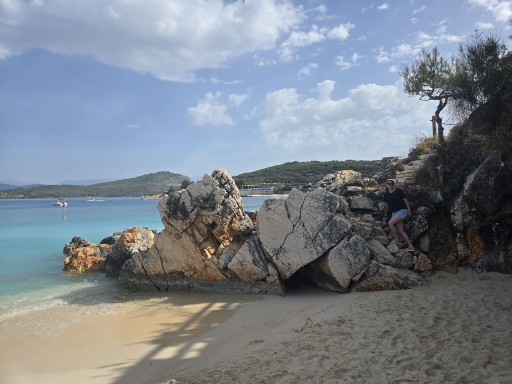
Among all the ports of call on the itinerary, it was Albania, specifically the coastal town of Sarandë, that lodged itself most firmly in Coffin's memory. Sarandë is, by the standards of mainstream Mediterranean cruise tourism, still finding its footing. And that, it turns out, is precisely what makes it so compelling. Coffin describes arriving to find construction happening right alongside the beach, "buildings going up, condos going up, restaurants on the wharf being built as we were swimming in the ocean." Rather than finding this off-putting, he found it energizing, a live snapshot of a destination in the act of becoming.
The sense of discovery extended well beyond the skyline. Coffin had arrived with a broadly European mental image of Albania, and the reality was something altogether different. "Surrounded by the main city there, it had a Middle Eastern feel to it, which I wasn't expecting," he recalls. "It didn't seem like European at all." What he found instead was a place with its own distinct rhythm, unhurried and genuinely welcoming. "It wasn't busy, it was nice and peaceful. People were talking to each other, respectful driving on the roads, crossing the streets. A nice friendly, family feel to it. A nice neighborly feel." For a travel professional whose job is to read the atmosphere of a place and translate it for clients, these observations carry real weight.
A Meal Worth the Journey
No travel story is complete without food, and Albania delivered one of the trip's most memorable culinary moments. Sitting down to a local meal, Coffin and Brenda were introduced to Albanian cuisine through a first course that stopped the conversation: baked brie with honey and crushed almonds on top. "Absolutely delicious," Coffin says, with the kind of unambiguous enthusiasm that only genuine surprise can produce. The meal continued with traditional Albanian meatballs accompanied by fresh peppers filled with a cream sauce, all finished with a scattering of ice cream around the plate. It was inventive, generous, and deeply local, the sort of meal that becomes a touchstone for an entire trip.
These flavors matter professionally as much as personally. For a travel advisor, being able to tell a client exactly what a destination tastes like, not in abstract terms but in specific, sensory detail, is a form of credibility that no amount of secondhand reading can replicate. Coffin understands this. "Visiting Albania showed us what the locals are like, what the town is like, what the culture is like, what the food is like, and certainly things to see there," he reflects. "I'll certainly tell people about it in more detail now that I've experienced it."
Who Should Go, and What to Expect
Coffin is clear-eyed about the kind of traveler Albania will suit right now. The destination rewards curiosity and flexibility above all else. "Travelers with an open mind to learn new cultures, new food, new experiences will enjoy this location," he says. It is not, at this stage, a destination for travelers who require polished infrastructure and seamless luxury at every turn. Construction is ongoing, the tourism ecosystem is still developing, and the experience retains a raw, unscripted quality that more established ports have long since lost. For the right traveler, that is the entire appeal.
For those willing to lean in, what awaits is something increasingly rare on heavily trafficked Mediterranean itineraries: a place that feels genuinely undiscovered. The locals are warm, the food is surprising, and the sense that one is witnessing a destination's arrival on the world stage lends the visit an almost documentary quality.
A Destination Worth Watching
Perhaps the most telling sign of how deeply Albania made an impression on Coffin is where his mind goes when he considers the future. He is not simply satisfied to have visited. He wants to return. "I'd be curious to go back in five years' time and see how much progress has been made and how much has been done for their local economy," he says. It is the instinct of someone who recognizes a turning point when he sees one, a destination at the precise moment before it becomes widely known, when it still belongs to the travelers bold enough to show up early.
For now, Coffin is already looking toward his next horizon. A Caribbean cruise aboard Norwegian Luna is on the calendar for September, another opportunity to experience firsthand what he recommends to others. It is, as ever, the work of an advisor who believes that the best thing he can offer any client is not a curated itinerary, but a story he has actually lived.